

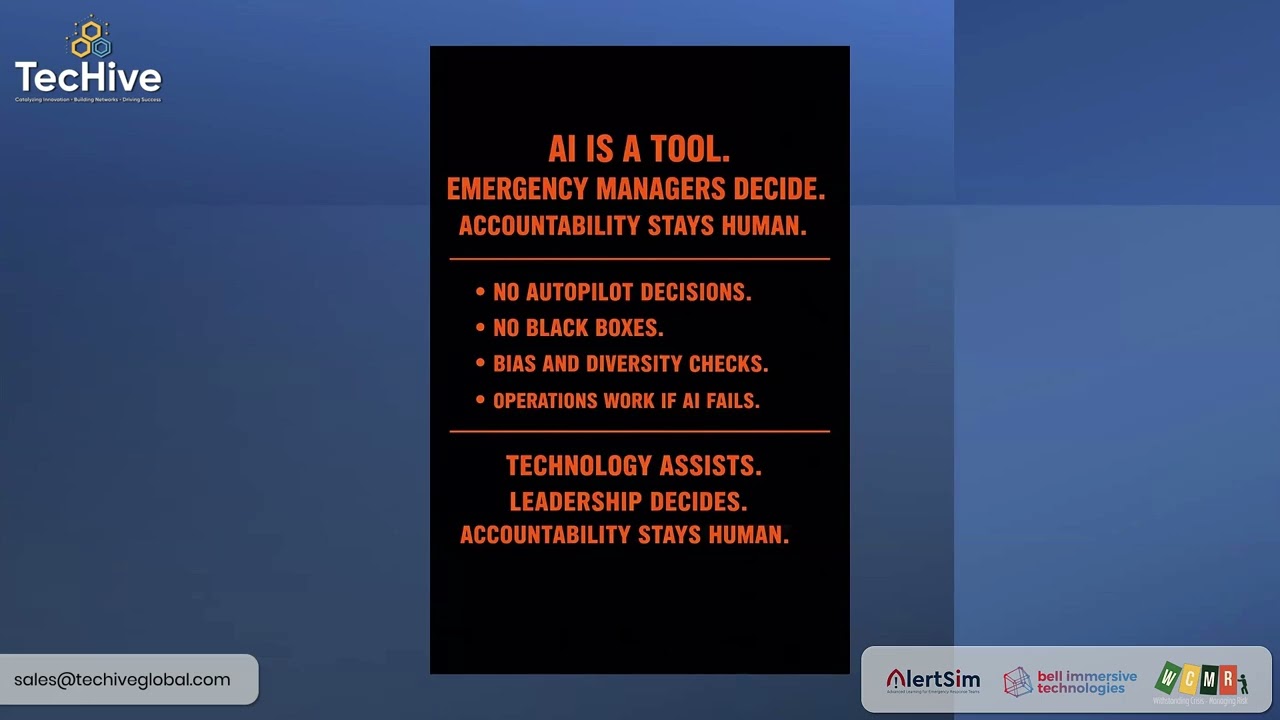
AI is already embedded in emergency management, dashboards, forecasting models, decision support systems, public information drafting. The question is no longer whether to use it. The question is who is accountable when it's wrong.
The answer is always the same: the responsible official. AI is never held accountable. When an AI-drafted warning sends people the wrong direction, or a predictive model deprioritizes the wrong neighborhood, the investigation doesn't end at the algorithm. It ends at the person who authorized the action. That accountability cannot be delegated, automated, or shared with a tool.
This shapes how AI should be governed in emergency management operations. AI has legitimate value for drafting, summarizing, generating options, training support, and reviewing plans — anywhere a human reviews the output before it drives action. It has no place issuing warnings autonomously, replacing incident command authority, or presenting predictive analysis as certainty.
Three principles should govern any deployment. First, explainability: if you cannot explain in plain language why the system produced a given output, don't act on it. Second, equity: AI reflects the data it was trained on, and disaster-affected communities, especially those historically underserved, are often underrepresented in that data. Equity review requires human judgment, not automation. Third, resilience: every AI tool must have a human override. If it cannot be shut off, it cannot be used.
Before any AI tool goes operational, three questions should be answered honestly: Does it improve outcomes for the people we serve? Is a human clearly in charge? Can operations continue without it when it fails?
Technology assists. Leadership decides. Accountability stays human.